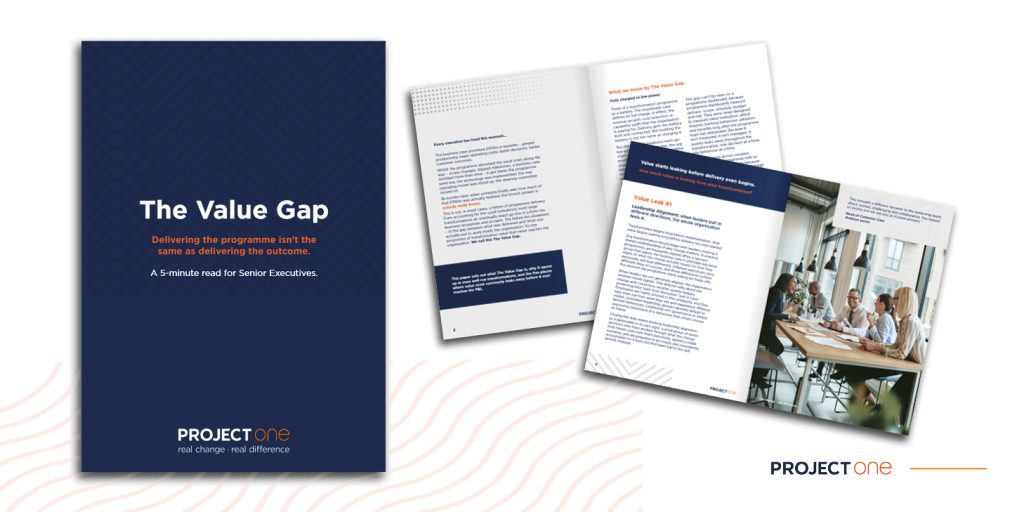
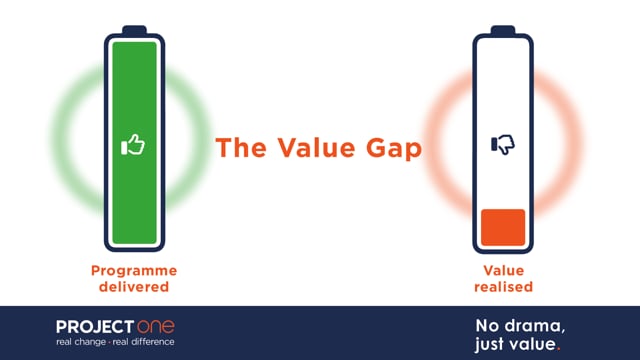
Most programmes are good at tracking cost, time and scope. Far fewer are good at tracking value. A benefits management framework is the structured, repeatable way an organisation defines, owns, tracks and reports the outcomes a change is meant to deliver, from a single project through to the wider portfolio. Without one, benefits are promised in a business case, quietly dropped during delivery, and never checked afterwards. With one, every steering meeting, stage gate and investment decision has a clear answer to the question: what is this actually achieving? Here is an animation to better define the area where the business ‘expects’ delivery and what value is ‘realised’, better known as ‘The Value Gap’.
What it is and what it isn’t
A benefits framework is not a spreadsheet bolted on at the end of a project, and it isn’t a one-off exercise to win funding approval. It’s a live thread that runs from the original case for change through to post-implementation review: what benefit is expected, who owns it, how it will be measured, and when it will land. Done well, it changes behaviour during delivery, not just reporting after it.
Lightweight vs formal frameworks
Not every initiative needs the same level of rigour. A small operational improvement might need only a one-page benefit statement and a named owner. A multi-year, multi-workstream programme needs a full benefits map, individual benefit profiles, a realisation plan and independent tracking. The skill is matching the weight of the framework to the scale and risk of the change — over-engineering a small initiative wastes effort and goodwill; under-engineering a large one loses control of the value case entirely.
Benefits maps, profiles and owners
Three building blocks do most of the work:
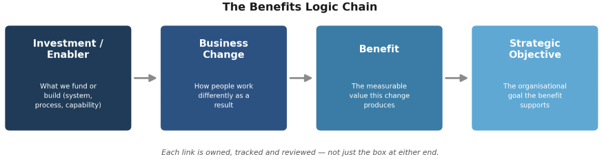
Benefits map: a single visual tracing how outputs (systems, process changes, new capability) lead to business changes, which in turn produce measurable benefits that support strategic objectives.
Benefit profile: a short document per benefit: baseline, target, measurement method, timing, dependencies and the enabling changes required.
Benefit owner: a named individual, ideally the person accountable for the operational area affected, who owns realisation — not just reporting a number, but making the changes needed to achieve it.
Without a named owner, a benefit is a hope, not a plan.
Scaling from programme to portfolio
The same discipline applies at every level, only the altitude changes.
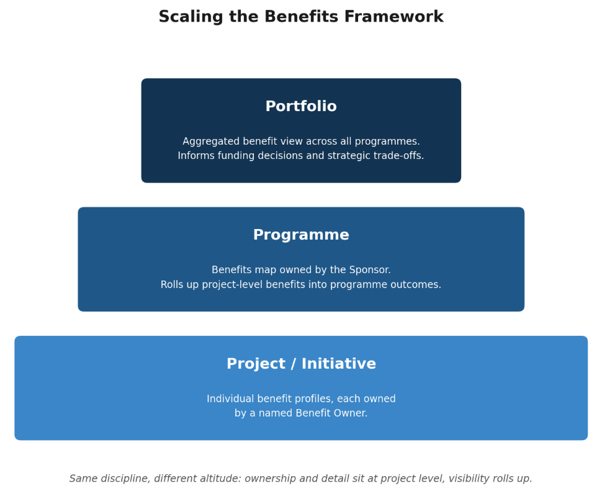
At project level, benefit profiles are detailed and owned locally. At programme level, these roll up into a benefits map that the Sponsor is accountable for, showing how individual pieces combine into the outcome the programme was funded to deliver. At portfolio level, benefits are aggregated across programmes to inform prioritisation, trade-offs and funding decisions — comparing initiatives on value delivered, not just cost or activity.
Alignment to strategy and the funding case
Every benefit should trace back to a strategic objective and forward to the funding case that justified the investment. This alignment is what protects a programme when priorities shift or budgets tighten: it’s far easier to defend an initiative when you can show precisely which strategic outcome it supports and how much value is already secured versus still at risk.
A framework only has value if it’s used at the moments that matter:
Stage gates: is the benefits case still valid before the next phase is funded?
Investment/steering reviews: is realisation on track against profile, and are enabling changes happening?
Post-implementation review: was the benefit actually achieved, and what does that tell future business cases?
Common pitfalls
Over-complexity: frameworks with excessive templates and metrics that nobody maintains or understands properly
Poor data: no agreed baseline, so “improvement” can’t be proven either way
Lack of ownership: benefits owned by the programme team rather than the business area that has to sustain the change
Benefits left at “go-live”: tracking stops the moment the project closes, before the benefit has actually had time to land.
Starting from scratch: practical guidance
Begin with the handful of benefits that matter most, not an exhaustive catalogue. Agree a simple, consistent template for benefit profiles before designing anything more elaborate. Assign owners early, ideally before delivery starts not once it’s underway. And build in a light governance cadence, even quarterly, so benefits are a standing conversation rather than an annual surprise.
On one recent programme with a UK private healthcare provider, the approach that worked was deliberately simple: each initiative defined on a single page: problem, benefit, owner, cost, risk. All tracked through consistent, lightweight structures rather than heavy methodology. That discipline, applied consistently, was what turned dozens of individually modest initiatives into a programme-level financial result. Simplicity, applied with rigour, tends to outperform complexity applied loosely. You can listen to the podcast where we go into more detail on this engagement here.
A benefits management framework works best alongside strong PMO governance, clear strategy alignment and disciplined portfolio prioritisation. If you’re building or refreshing your approach to benefits realisation, get in touch we’d be glad to share more of what we do best.

 How drama free is your change programme? take our free programme health check
 Our change and transformation Podcast Listen to our latest Podcast