Change Management approaches to deliver better business transformation

Our customer started in 2017 with less than 30 employees, and had grown to over 450 employees with billions of pounds worth of assets under management. The business had followed a strategy to get to profitability as fast as possible and had followed a multi-solution approach for their IT architecture, as many of the business areas were highly specialised.


The Change Function had a poor reputation following a major programme came in massively over budget and costs. This also highlighted the significant increase in IT solution and business process complexity as the organisation had grown without a commensurate change in the change delivery processes and governance.

Challenge

With the business growing and with one very high-profile programme failure, which required significant 3rd party support to recover, the Board had lost confidence in the Business Transformation Function. The Board set an action to have an independent review on how the business should deliver change in a more robust and efficient way.


Whilst the Business Transformation team had started to improve and had already produced a “self-help” list, the changes in the team, the pressure of delivery and lean staffing, left too little time to make significant progress to improve the way change is delivered.


The business also has significant growth ambitions and requested a review of their Business Transformation Framework and more general change capability to significantly improve their delivery performance and success rates.


The major failed programme had been consuming a high percentage of the change resources, and this situation had been running for 18-24 months. This had created a significant backlog of business change demand and some “shadow” IT solutions starting to appear or business units starting to do their own supplier selection without the proper requirements processes.


The business had not invested much in documentation of processes, ways of working and operating procedures which then delayed the start of most projects as this work was undertaken.


What was the business risk and impact of doing nothing?


  • Without changes to their ways of working the business was risking further expensive mistakes and a business that was unable to grow at the desired rates
  • Poor delivery also risked regulatory compliance failures and fines if the organisation failed to delivery key regulatory change initiatives
  • Staff morale was also low with the function having a poor reputation with the broader business community which risked further staff losses along with the associated knowledge.
Approach

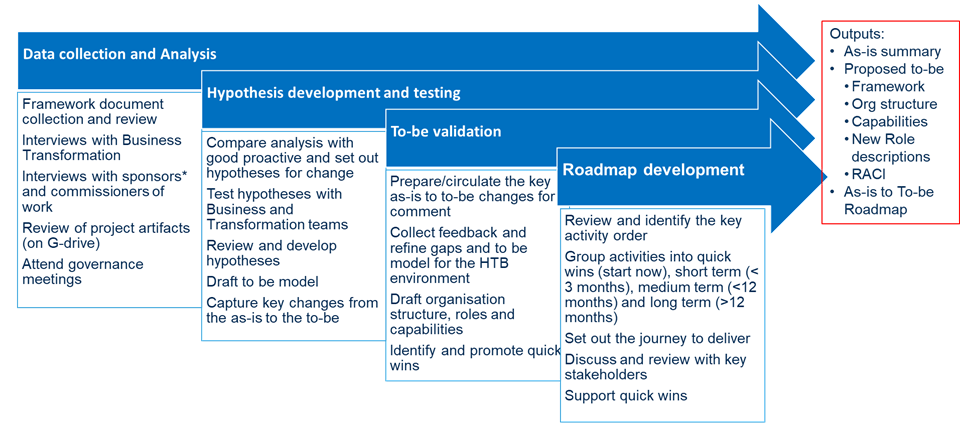
The Board requested an independent review of the Business Transformation Framework and Project One was selected to support with a 10-week assignment with a senior Project One consultant.


The approach the assignment took is set out in the diagram below.


What were the key challenges we needed to overcome?


  1. The time period of the review was just at the back of the failed programme, so it was hard for many to see beyond this failure, especially for new joiners who had always lived under this distraction. Those that could, would go back to a time when the organisation was smaller, less complicated and things happened – “the good old days”. Getting real data was difficult, especially as the records were poor.
  2. The business had just lost its CFO of 6 years, 2 weeks prior to the assignment starting, this had required a reshuffle of the Leadership Team as well as added workload.
  3. There were also a number of broader factors, external to the organisation, which were placing capital constraints on the business and limiting further spend.
  4. Organisational communications were poor with expectations that “other” parties should or would communicate key decisions downwards. This was not happening, leading to a lot of misinformation around the change function.
  5. The budgetary set-up made it look like Business Transformation were allocators of capital and resources to projects – this led to a reputation of the Transformation function being seen as the gatekeeper or simply not delivering.


As a private equity backed organisation, staffing levels across the organisation were lean which made it harder to engage people or left them focussing on the tactical issues and no time to look at strategically working out the way forward.


There was significant pressure to meet business targets despite the lack of capital spend and some tensions within the Business Transformation team with some very different styles of working. This combined with the fact a number of the team were on home-based contracts and were rarely in the office added to the challenge.

Outcome

The organisation now has a structured way to improve their delivery performance by thinking more broadly about the problem and to focus not only on delivering well but also to ensure the business has a more structured approach to selecting the right projects which match with the broader organisation and technical architectures.


The plan and approach were conducted in conjunction with the Business Transformation Leadership Team so that there was buy-in to the recommendations and a clear, agreed way forward.


The implementation approach was also designed to show quick wins and keep the management focus through short sprint and reporting cycles.


Ultimately the poor scoping, poor planning of resources, selection of lower impact projects, last minute changes and slow decision making was creating stress and pressure on individuals. This was contributing to high staff turnover and low staff satisfaction scores.


What impact does this have on the end-customer? Ultimately the right (most impactful) customer service improvements will be delivered more quickly and efficiently, improving the user experience and functionality.


We have left a change capability within the organisation which has the capability to continuously improve to drive out further efficiencies.  The current team now have the confidence and external backing they are doing the right things in the right order.


Project One value Add


  • Why they needed to use us
    • They needed an external view on their change capability, both to have the right “authority and independence” but also to allow the internal team to continue with the fire fighting.
  • Value we bring
    • We brought the experiences from multiple customers to help tailor the solution which will work. Templates and recommended processes were handed across to help kick start the improvements
  • What makes us different to our competitors
    • The customer team really appreciated the collaborative and open approach so that their voice was heard, challenged but used where appropriate and benefited from a 3rd party to bounce ideas and thinking off.


Are you looking for critical business transformation?

Let’s talk real change
Related insights and customer stories
Sign up to our eNewsletter

Get the latest news, relevant insights and expertise from our change experts

Marketing updates confirmation(Required)
Privacy policies confirmation(Required)