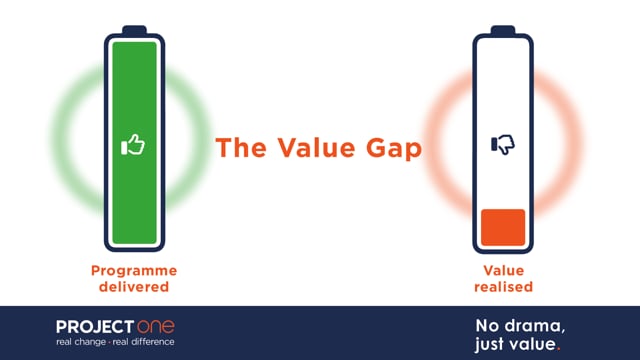
Organisations invest millions in transformation programmes; new ERP platforms, digital capabilities, operating models, and ways of working. Yet too often, the expected benefits fail to materialise. The technology may go live on time, but adoption stalls, workarounds emerge, and the return on investment is diluted.
At the heart of this challenge isn’t technology. It’s change.
An effective Change Management approach bridges the gap between what the organisation is trying to achieve and how people actually behave differently as a result. It turns vision into execution, ambition into adoption, and investment into measurable outcomes.
This article explores how to design an effective Change Management approach, covering all of the change lifecycle phases, from vision through to execution. We also explore why getting this right before implementation is key to success.
What is a Change Management approach and why does it matter?
It’s a structured plan for how people will be supported to adopt new ways of working in order to realise business outcomes.
- It’s not a communications plan.
- It’s not a training schedule.
- It’s not something that can be “bolted on” once delivery is underway.
An effective Change Management approach addresses four fundamental questions:
- Why are we changing?
- What will be different for people?
- How will adoption be achieved and sustained?
- How will we know the change has delivered value?
Without this, change activity becomes reactive and tactical, focused on outputs rather than outcomes. Teams deliver artefacts but struggle to influence behaviour. Stakeholders disengage. Leaders send mixed messages. Benefits are assumed rather than realised.
Designing the Change Management approach before implementation allows organisations to:
- Align transformation goals with business priorities
- Make deliberate choices about the change and investment
- Establish strong sponsorship and governance early
- Create a change roadmap that integrates with programme delivery.
From vision to execution: the foundations
An effective Change Management approach connects vision, method, and execution. It provides direction without being overly rigid, and structure without restricting adaptability.
Four core components underpin this:
- Vision
- Roadmap
- Sponsorship
- Governance.
Each plays a distinct role in moving from intent to impact.
Vision: anchoring change to purpose and outcomes
Every Change Management approach must start with a clear and compelling vision.
The vision articulates:
- What the organisation is trying to achieve
- Why the change matters now
- What success looks like beyond go-live.
It’s important that this vision is expressed in business and human terms, not programme or system language.
For example:
- “Standardising processes” becomes “reducing manual effort and improving decision-making.”
- “Implementing ERP” becomes “creating a single source of truth that enables growth and control.”
A strong change vision:
- Connects transformation to strategic business objectives
- Resonates with leaders and frontline teams
- Provides a consistent narrative throughout delivery.
Without a shared vision, change activity lacks direction. With it, every intervention, from communication and training to leadership engagement, reinforces the same message.
Roadmap: turning strategy into an executable plan
A change roadmap translates vision into a sequenced, practical plan.
Unlike a project plan, a change roadmap focuses on people readiness and adoption, not technical milestones. It answers the question: what needs to happen, and when, for people to be ready to change?
An effective roadmap:
- Aligns to the overall transformation and delivery plan
- Identifies key change milestones (e.g. leadership readiness, role impacts, capability uplift)
- Recognises that adoption happens over time, not at go-live
- Balances pace with capacity.
Importantly, the roadmap reflects the chosen change approach. A large, enterprise-wide ERP transformation may require a structured, phased approach, while smaller changes may benefit from more iterative methods.
The roadmap also helps set realistic expectations with stakeholders, reinforcing that sustained adoption and benefits realisation extend well beyond implementation.
Sponsorship: mobilising leaders to drive change
Sponsorship is one of the most critical and most underestimated elements of an effective Change Management approach.
Effective sponsorship goes beyond visible endorsement. It requires leaders to:
- Align on the case for change
- Model new behaviours
- Reinforce priorities through decisions and actions
- Actively address resistance.
The Change Management approach should clearly define:
- Who the sponsors are at each level
- What is expected of them
- How they will be supported to fulfil their role.
This is where leadership alignment becomes essential. Misaligned leaders create confusion and erode trust, even when change activity is well designed. A deliberate focus on leadership alignment ensures that the organisation hears a consistent message and sees it reinforced in practice.
Sponsorship is not a one-off event; it is an ongoing commitment that must be planned, enabled, and governed.
Governance: enabling decisions and managing risk
Strong governance provides the structure needed to make informed decisions, manage risks, and maintain focus on outcomes.
Change governance should:
- Integrate with programme and transformation governance
- Provide clear escalation paths for people related risks
- Track adoption, readiness, and benefits alongside delivery metrics
- Enable timely decisions that protect value.
Too often, governance focuses exclusively on scope, cost, and schedule, while adoption risks surface too late. Embedding change governance ensures that people impacts are considered as part of overall transformation health, not as an afterthought.
Aligning the Change Management approach to business outcomes: a practical example
Consider an organisation implementing a new ERP system with the stated objective of improving financial control and operational efficiency.
A misaligned Change Management approach might focus on:
- Training users on system functionality
- Sending communications about key dates
- Measuring success by system usage alone.
A Change Management approach aligned to business outcomes would instead address:
- What behaviours must change to improve financial control?
- What decisions should be easier or faster post-implementation?
- How will managers use new data differently?
The results might include:
- Leadership workshops focused on new decision-making expectations
- Role-based capability development aligned to outcomes, not transactions
- Adoption measures linked to cycle time, data quality, or forecast accuracy
- Reinforcement mechanisms tied to performance management.
By explicitly linking change activity to outcomes, the organisation moves beyond adoption and towards measurable value.
Change method and change frameworks
A Change Management Strategy also defines the change method or how change will be delivered.
This may draw on established Change Frameworks (such as ADKAR, Kotter, or Prosci), but in our experience, frameworks should be treated as tools, not prescriptions. The most effective approaches adapt frameworks to the organisation’s context, culture, and level of change maturity.
Key considerations when selecting a change approach include:
- Scale and complexity of the transformation
- Degree of behavioural change required
- Organisational readiness and capacity
- Leadership capability and engagement.
A clear approach ensures consistency, provides a shared language, and helps teams make informed design choices throughout execution.
From strategy to execution: making change stick
Designing a Change Management approach is not the end, it is the foundation.
Execution requires:
- Discipline to stay aligned
- Flexibility to adapt as conditions change
- Ongoing measurement and course correction.
The most successful transformations treat this as a living artefact, revisiting and refining it as the programme evolves.
When strategy and execution remain connected, organisations are far more likely to:
- Achieve sustained adoption
- Realise intended benefits
- Build internal capability for future change.
Conclusion
An effective Change Management approach is not about doing more change activity, it is about doing the right activity, in the right way, for the right reasons.
By anchoring change in vision, translating it through a clear roadmap, enabling strong sponsorship, and reinforcing it with governance, organisations can move confidently from vision to execution.
Do you need Change Management expertise?
At Project One, our team of change experts all have a minimum of 15 years experience in leading complex change and transformation programmes, across all sectors. If you are embarking on or already delivering a transformation programme and would like some guidance or just a sounding board, please get in touch

 How drama free is your change programme? take our free programme health check
 Our change and transformation Podcast Listen to our latest Podcast