Achieving successful organisational transformation is only half the challenge, the real test lies in ensuring new behaviours, processes and ways of working are sustained over time. Effective change sustainment requires organisations to move beyond implementation and establish mechanisms for continuous feedback and performance measurement. By gathering employee insights, monitoring outcomes and making ongoing improvements, organisations can reinforce adoption, increase engagement and maximise the value of change initiatives.
Whether introducing new technologies, implementing operational improvements or transforming organisational culture, continuous measurement and feedback provide the information needed to embed change successfully and prevent a return to old behaviours.
Why change sustainment matters
Many organisations invest significant effort in launching change programmes but fail to maintain momentum after implementation. Common challenges include:
Employees reverting to previous practices
Loss of leadership focus
Declining engagement
Inconsistent adoption
Unclear accountability
Without ongoing reinforcement and support, even the most successful programmes can struggle to deliver long-term benefits.
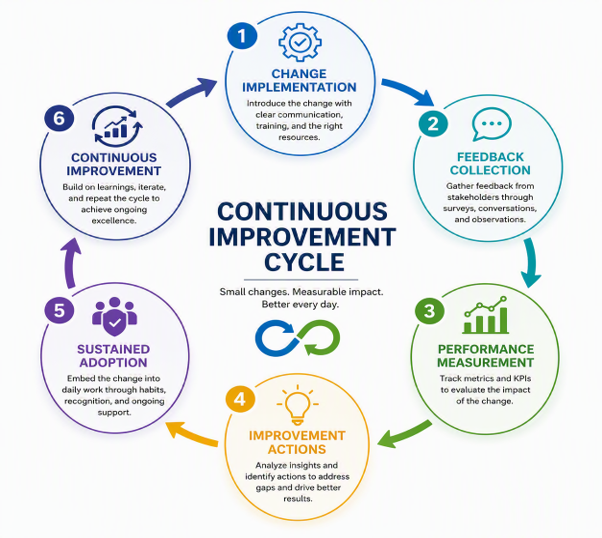
Embedding change and ensuring new ways of working become adopted within daily operations and organisational culture requires organisations to monitor progress continuously, listen to employees and act on insights.
The power of continuous feedback
Feedback is one of the most valuable tools for sustaining change. A continuous feedback approach enables organisations to understand how employees are experiencing change while identifying improvement opportunities before issues become significant barriers. This feedback helps organisations:
Identify adoption challenges early
Improve employee engagement
Increase trust and transparency
Validate change effectiveness
Drive ongoing improvement
Most importantly, it demonstrates that leadership is listening and willing to adapt. Rather than waiting until programme completion, successful organisations gather feedback throughout the change journey.
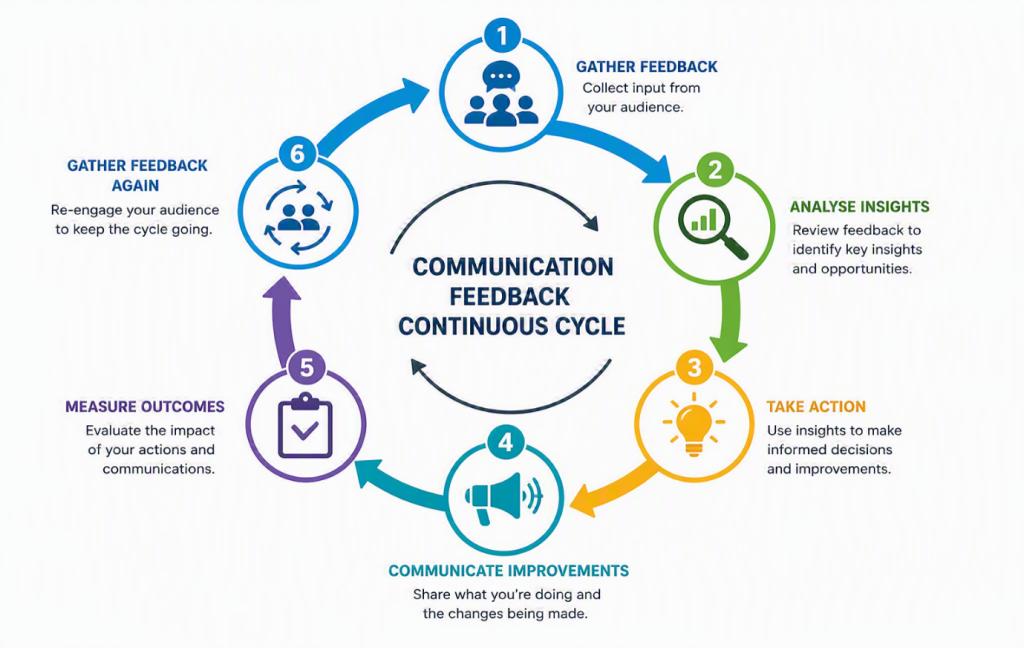
Creating effective feedback loops
A feedback loop occurs when information is collected, analysed, acted upon and then communicated back to stakeholders. The cycle looks like this:
This continuous cycle enables organisations to evolve and improve change initiatives over time. Feedback that is collected but never acted upon can damage trust and reduce future participation.
Performance measurement: turning data into action
While feedback provides qualitative insights, performance measurement provides quantitative evidence of progress. Together, they create a balanced view of change adoption and effectiveness. Organisations establish measurement frameworks that track both people and business outcomes.
Measurement helps leaders answer important questions:
Is the change being adopted?
Are desired behaviours occurring?
Are expected business benefits being realised?
Where should support be increased?
Which areas require corrective action?
Without meaningful measurement, leaders often rely on assumptions rather than evidence.
Employee Surveys – Surveys provide valuable insight into employee perceptions and experiences. Topics may include:
Understanding of change objectives
Confidence levels
Training effectiveness
Leadership support
Overall engagement
Pulse surveys can be particularly effective because they capture feedback frequently and identify emerging trends.
Key Performance Indicators (KPIs) – KPIs help measure whether change objectives are being achieved. Examples include:
Adoption rates
Process compliance
Productivity improvements
Customer satisfaction scores
Error reduction rates
Employee retention levels
KPIs should align directly with the intended outcomes of the change initiative.
Performance Dashboards – Dashboards allow leaders to monitor performance in real time. They provide visibility into:
Adoption progress
Training completion
Employee sentiment
Operational performance
Business benefits
Dashboards, such as the example below, help leadership teams make informed decisions based on current data rather than historical reports.
Common Challenges and How to Overcome Them
Low feedback participation – Employees may stop providing feedback if they believe it is ignored. Solution: Share actions taken and demonstrate the impact of employee input.
Too many metrics – Excessive measurement can create confusion and reporting fatigue. Solution: Focus on a small set of meaningful KPIs aligned to business outcomes.
Inconsistent leadership engagement – Sustainment often weakens when leaders shift attention to new priorities. Solution: Build accountability for change outcomes into leadership objectives.
Delayed response to findings – Slow action reduces confidence in measurement activities. Solution: Establish clear ownership and timelines for responding to feedback and performance insights.
Connecting sustainment to post-programme reviews and continuous improvement
Continuous feedback and measurement should extend beyond formal implementation activities. Post-programme reviews provide opportunities to evaluate:
What worked well
What could be improved
Adoption outcomes achieved
Lessons for future initiatives
Likewise, continuous improvement programmes ensure organisations continue refining processes, enhancing employee experiences and delivering greater value over time. Together, these practices create a foundation for sustainable organisational success.
Ultimately, organisations that listen, measure, improve, and reinforce are far more likely to sustain change and realise the full benefits of their transformation investments.
If you’d like to unlock the full potential of your business or just need a sounding board, contact us today to discover how we can help you achieve your goals.

 How drama free is your change programme? take our free programme health check
 Our change and transformation Podcast Listen to our latest Podcast