Successful transformation depends on more than a strong business case or a well-funded programme, it requires a clear approach for guiding people, leaders, and teams through change. Change management models provide this structure, but no single model works universally. Each brings strengths and limitations, and the real value lies in tailoring the approach to match your organisation’s culture, readiness, and strategic intent.
We read in the article ‘Do you have a change architecture for your transformation programme?’ the importance of frameworks as models, to frameworks as architecture to support the whole of your organisation, ensuring you have an all-round view of what you want to achieve. In this article we delve more into the most recognised frameworks, ADKAR, Kotter’s 8 Steps, Lewin’s Model, and the McKinsey 7 S Framework, exploring their advantages, drawbacks, and ideal use cases.
It’s important to remember that a strong change management approach is important to support and embed a framework in your organisation, and needs to be adapted and tailored to align with your Change Strategy and Transformation Planning. It does not deliver successful transformation alone.
Summary of Key Change Management Frameworks
ADKAR
Individual Focus: A goal-oriented framework designed to facilitate individual change, based on the principle that organisational transformation succeeds only when individuals change.
The 5 elements of ADKAR:
It is an acronym for five sequential outcomes…
Awareness: of the need for change
Desire: to support and participate in the change
Knowledge: of how to change
Ability: to implement the required skills and behaviours
Reinforcement: to sustain the change
Key Aspects of the Model
Focus: It addresses the personal, individual, human side of change, rather than just technical or process changes.
Sequential Progression: Individuals must move through these stages in order; addressing stages out of order can lead to failure.
Diagnostic Tool: ADKAR helps managers identify exactly where in the process a change is getting stuck (a “barrier point”).
Application: It is used for planning, managing resistance, and measuring progress during organisational, project, or personal changes.
The ADKAR model centres on the human side of change, helping organisations understand what individuals need to adopt new behaviours or systems.
Pros
Practical and easy to integrate into project delivery
Highlights specific adoption barriers
Includes reinforcement, ensuring changes stick
Cons
Not a full organisational transformation model
Requires structured governance to apply consistently
Best fit scenarios
Technology implementations
Process standardisation
Behavioural or skill-based change
Projects where adoption needs to be measured and managed
Kotter’s 8 Step Model
Focus: It emphasises creating urgency, building a guiding coalition, developing a strategic vision, empowering action, generating short-term wins, and anchoring new approaches into the corporate culture.
Kotter’s 8 Steps for Leading Change:
Create a Sense of Urgency: Identify potential threats and opportunities to inspire immediate action. Build a Guiding Coalition: Assemble a team with sufficient power, expertise, and credibility to lead the change.
Form a Strategic Vision: Define a clear, compelling vision that differentiates the future from the past.
Enlist a Volunteer Army (Communicate the Vision): Communicate the new vision frequently and powerfully to create buy-in and generate active support.
Enable Action by Removing Barriers: Remove obstacles, such as inefficient processes or structures, that restrict change.
Generate Short-Term Wins: Produce, track, and celebrate visible, unambiguous performance improvements early in the process to build momentum.
Sustain Acceleration (Build on the Change): Use the momentum from early wins to tackle larger, more complex systems and processes.
Institute Change (Anchor in Culture): Make the new behaviours and approaches stick by anchoring them in the organisation’s culture and norms.
This model is considered highly effective for managing both the rational and emotional components of organisational transformation.
Kotter’s framework is widely used for complex, cross functional transformation where sponsorship and cultural alignment are critical.
Pros
Strong focus on leadership and mobilisation
Encourages visible short term wins to build momentum
Focus: Psychological journey through change – the model helps leaders understand how to move people from the current state to a desired future state while managing resistance and embedding new behaviours.
Model:
Unfreeze: This stage prepares the organisation to accept that change is necessary.
Challenging the status quo
Communicating the need for change
Reducing resistance by addressing fears or uncertainty
Building awareness of the problem or opportunity
Change: Once the organisation is unfrozen, the actual transition can occur.
Implementing new processes, systems, or behaviours
Providing training and support
Continuing communication to guide people through uncertainty
Encouraging new ways of working
Refreeze: After the change has been made, the organisation stabilises in the new state.
Reinforcing new behaviours through systems, culture, and rewards
Documenting and standardising new processes
Monitoring long-term adoption
Celebrating wins to strengthen commitment
Lewin’s model simplifies change into three clear stages and is often used to explain why people resist change.
Pros
Easy to explain and understand
Suitable for small or well-defined changes
Helpful for early education about change
Cons
Too simple for iterative or complex environments
The idea of “refreezing” is less relevant in fast-moving organisations
Best fit scenarios
Team-level or incremental changes
Introduction to change management concepts
Scenarios requiring clarity over detailed process
McKinsey 7 S Framework
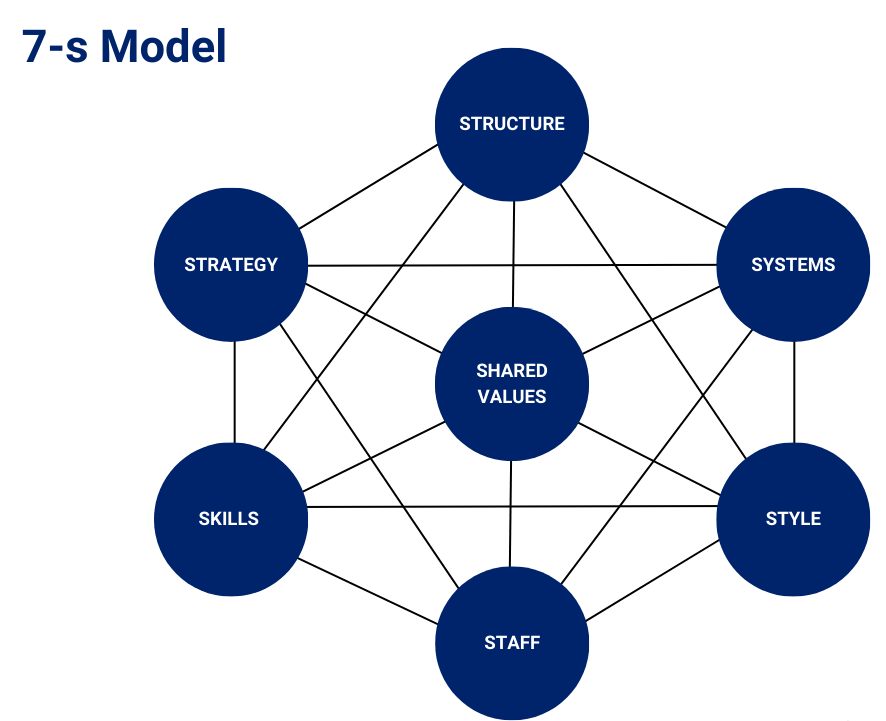
Focus: the 7 S Framework helps organisations evaluate how well their internal elements are aligned to achieve strategic objectives.
The 7 S model is a powerful diagnostic tool for identifying where misalignment may hinder transformation.
Model
The model says success depends on the alignment of seven elements, divided into Hard S’s and Soft S’s.
Hard Elements (Easier to Define and Influence)
These are directly shaped by leadership and strategy.
1. Strategy
The plan to build competitive advantage and win in the market – choices about where to play and how to succeed.
2. Structure
How the organisation is arranged – hierarchy, reporting lines, teams, and coordination mechanisms.
3. Systems
The processes and procedures that run the organisation – performance management, IT systems, workflows, budgeting, etc.
Soft Elements (More Intangible and Cultural)
These are harder to measure but crucial for alignment.
1. Shared Values (the central element)
Core beliefs and cultural norms that guide behaviour; the organisation’s purpose, mission, and ethos.
2. Skills
The competencies and capabilities of individuals and teams—what the organisation is really good at.
3. Style
Leadership style and the broader organisational culture—how leaders behave and how work gets done.
4. Staff
People and talent—recruitment, development, motivation, demographics, and how people are deployed.
Pros
Holistic view of organisational strengths and gaps
Highly effective for complex transformations
Highlights interdependencies across the organisation
Cons
Not a step-by-step implementation model
Requires analytical capability and organisational insight
Best fit scenarios
Transformation planning
Operating model or organisational design
M&A integration
Strategy alignment work
Tailoring Change Frameworks to your organisation
No two organisations change in the same way. That’s why you can’t apply frameworks “as is”, they need to be adapted to your culture, maturity, leadership style, and strategic objectives. The right combination creates a structured yet flexible approach that accelerates implementation, increases adoption, and reduces risk.
Adapting to culture, risk, and readiness
Different organisations require different approaches:
High trust, collaborative cultures benefit from empowerment based change
Regulated industries may need stronger governance and control
Rapid growth businesses often need shorter planning cycles and iterative implementation
You shape the methodology to fit the environment, not the other way around.
How Change Models improve transformation success
Using structured change models delivers clear benefits:
Higher adoption through targeted training, communication, and support
Reduced resistance thanks to strong narratives and sponsorship
Greater predictability through defined milestones and measurable outcomes
Better alignment between leadership intent and operational reality
Sustained results as new behaviours and practices become embedded
Organisations that use formal change management can consistently outperform those that don’t, achieving higher success rates and faster return on investment.
Change management models such as ADKAR, Kotter’s 8 Steps, Lewin, and the McKinsey 7S Framework each offer valuable perspectives on how to guide people and organisations through change. But the real advantage comes from applying and tailoring them in ways that reflect your organisation’s culture, strategy, and level of readiness.
Project One helps clients select, blend, and adapt these frameworks to unlock the full potential of transformation. Our team of change experts support, lead and deliver complex change and transformation programmes across all sectors. If you would like some guidance or just a sounding board, please get in touch.

 How drama free is your change programme? take our free programme health check
 Our change and transformation Podcast Listen to our latest Podcast