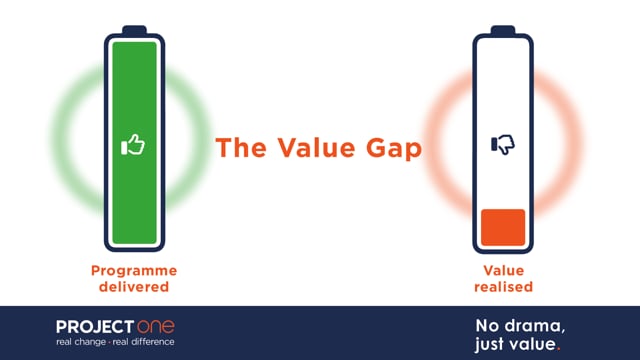
Any organisational change, whether big or small, depends on more than just strategy and technology, it relies on the people. Effective change management is a critical component of any transformation programme because even well-designed initiatives can fail when employees are unwilling or unable to embrace the change. By focusing on employee engagement and using proven techniques for overcoming change resistance, leaders can reduce disruption, improve adoption rates and create a more resilient workforce.
Resistance should not be viewed as opposition for its own sake. In most cases, it is a natural response to uncertainty, perceived risk, or previous negative experiences with change. Organisations that understand the causes of resistance and address them proactively are far more likely to achieve successful and sustainable outcomes.
Understanding resistance to change
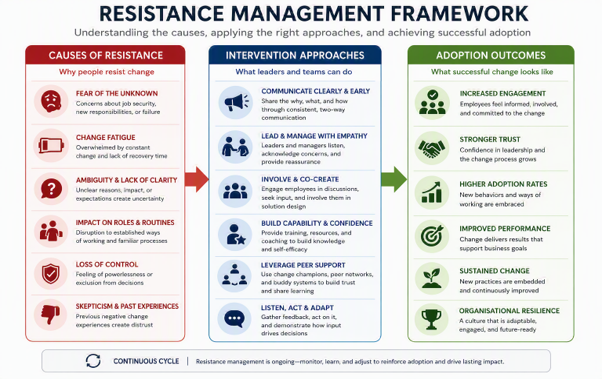
Resistance occurs when individuals or groups hesitate, delay, oppose or disengage from a proposed change. While resistance is often viewed negatively, it can provide valuable insights into concerns, risks and implementation challenges that leaders may have overlooked.
People often resist change when they do not understand:
Why the change is occurring
How it affects them
What success looks like
What support will be available
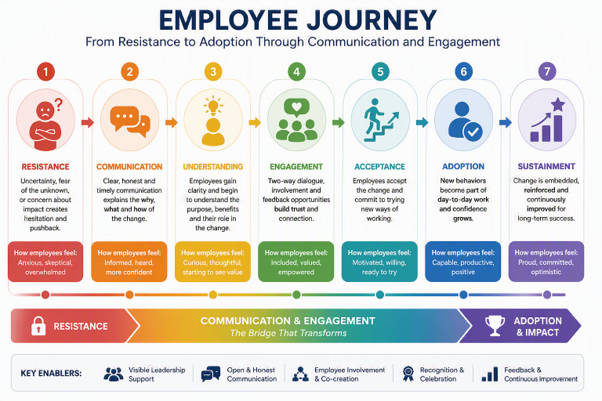
The importance of employee engagement
One of the strongest predictors of successful change is employee engagement. Engaged employees are more likely to:
Participate actively
Provide constructive feedback
Support colleagues
Advocate for change
Maintain commitment during challenges
Rather than treating employees as passive recipients of change, successful organisations involve them as active contributors throughout the transformation journey. When employees feel heard and valued, resistance often decreases naturally.
Practical resistance management techniques
While every organisation is different, several proven approaches consistently help reduce resistance and improve adoption.
Transparent and Consistent Communication
Communication remains the foundation of effective resistance management. Employees are generally more accepting of change when they understand:
The reason for the change
The expected benefits
The implementation timeline
Their role in the process.
Leaders should communicate early, frequently and honestly. Effective communication channels include:
Town hall meetings
Team briefings
Leadership videos
Frequently asked questions (FAQs)
Dedicated change portals
The most successful communications do not simply share information – they encourage dialogue.
Coaching and Manager support
Direct managers play a critical role in overcoming change resistance. Employees often trust their immediate leaders more than organisational communications. Managers can support change by:
Answering questions
Addressing concerns
Reinforcing priorities
Providing personalised guidance
Recognising achievements.
Coaching helps individuals navigate uncertainty and develop confidence in new ways of working. Organisations that invest in manager coaching typically see stronger adoption outcomes than those relying solely on corporate communications.
Peer Support Networks
People are often influenced by colleagues experiencing the same challenges. Creating peer support structures can accelerate adoption by providing practical assistance and encouragement. Examples include:
Employees frequently find peers more relatable than project teams, making these networks highly effective in reducing resistance.
Active Listening and Feedback
Resistance frequently increases when employees believe their concerns are being ignored. Organisations should create opportunities to gather and act on feedback through:
Surveys
Workshops
Focus groups
Team discussions
Open-feedback channels.
Importantly, leaders should demonstrate how feedback influences decisions. Visible action builds trust and reinforces engagement.
Using Change Management frameworks
Structured frameworks provide practical guidance for managing resistance and supporting adoption. Two very effective frameworks are:
ADKAR Model – focuses on five elements required for individual change:
Awareness – Employees understand why change is necessary
Desire – Employees choose to participate and support the change
Knowledge – Employees learn how to change successfully
Ability – Employees develop the skills required to perform effectively
Reinforcement – Organisations sustain new behaviours over time.
When resistance emerges, leaders can often identify which ADKAR element requires additional support.
Lewin’s Change Model
Kurt Lewin’s model remains one of the most widely recognised approaches to change management.
Unfreeze – Prepare the organisation by creating awareness and readiness for change
Change – Implement new behaviours, processes, or systems
Refreeze – Embed new ways of working into everyday operations.
This framework highlights the importance of not only introducing change but also reinforcing it until it becomes the new normal.
Effective resistance management is not about eliminating concerns – it is about understanding and addressing them constructively. Resistance is a natural human response to uncertainty, fatigue and ambiguity, but it can be successfully managed through strong communication, coaching, peer support and meaningful employee engagement.
Frameworks such as ADKAR and Lewin’s Change Model provide valuable structure for guiding transformation efforts, while initiatives like Change Champions and coaching programmes help reinforce adoption at a local level.
Ultimately, organisations that prioritise listening, engagement and support are far better positioned for overcoming change resistance and achieving sustainable change outcomes that deliver lasting value.
If you’d like to unlock the full potential of your business or just need a sounding board, contact us today to discover how we can help you achieve your goals.

 How drama free is your change programme? take our free programme health check
 Our change and transformation Podcast Listen to our latest Podcast