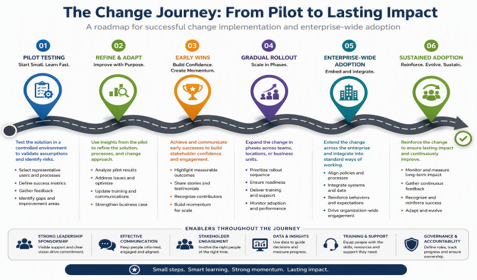
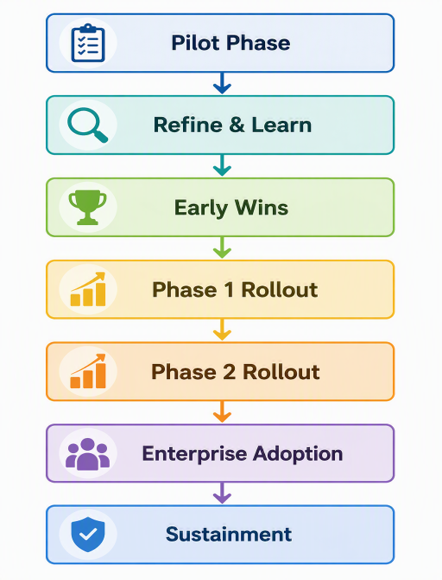
Whether introducing new processes, technology platforms, operating models or cultural initiatives, the most effective large-scale change programmes follow a structured path that includes testing, learning, scaling and continuous improvement.
Organisations that invest in pilot programmes, carefully planned change rollouts, and the celebration of early successes are significantly more likely to achieve sustainable transformation outcomes. This approach reduces risk, builds stakeholder confidence and creates the momentum needed to expand change across multiple business units.
From defence organisations modernising command systems, to financial institutions implementing digital banking capabilities, to retailers transforming customer experiences through technology, the principles remain remarkably consistent.
Successful change at scale starts small, learns fast and grows with purpose.
One of the most common causes of change failure is attempting to implement a solution across an entire organisation before validating it in a real-world environment.
Pilot programmes provide a controlled setting where organisations can test assumptions, identify risks, gather feedback and refine approaches before committing significant resources to a full deployment.
Key benefits of pilot testing
Risk reduction
Pilots expose operational, technical and behavioural issues before they affect the entire organisation. For example, a defence organisation introducing a new logistics management platform may initially deploy it within a single brigade or operational unit. Lessons learned regarding workflows, training requirements or system integration can then be addressed before broader deployment.
Improved user adoption
Pilot participants provide invaluable feedback about usability, communication effectiveness and training needs. A finance organisation implementing a new customer relationship management (CRM) platform may discover that frontline advisors require additional workflow automation or simplified reporting features. Addressing these issues early improves adoption during wider rollout.
Evidence-based decision making
Pilot results provide measurable evidence regarding benefits, costs and implementation requirements. Leaders can use pilot outcomes to answer critical questions:
Is the solution delivering the expected value?
Are employees adopting new ways of working?
What support models are required?
What unforeseen challenges have emerged?
This evidence strengthens business cases and increases stakeholder confidence.
Designing effective pilot programmes
Not all pilots generate meaningful insights. The most effective pilot programmes are intentionally designed to reflect real-world conditions. Consider including:
Representative user groups
Clear success metrics
Defined timelines
Regular feedback mechanisms
Executive sponsorship
Structured lessons-learned reviews
A retail organisation piloting a new inventory visibility system, for example, might select stores of different sizes and locations to ensure findings are representative of wider business operations. The objective is not simply to prove the solution works, but to learn how it can be implemented successfully at scale.
Once pilot testing demonstrates success, organisations must carefully communicate results and highlight achievements. Early wins are small but visible successes that demonstrate the value of change and encourage broader support.
People often remain sceptical during transformation initiatives because they fear disruption, increased workloads or uncertain outcomes. Early wins help replace uncertainty with evidence.
Communicating early wins effectively
Early wins only create momentum if people know about them. Successful organisations develop communication strategies that showcase progress through:
Leadership briefings
Town hall meetings
Success stories
Internal newsletters
Performance dashboards
Video testimonials
The focus should be on outcomes that matter to stakeholders. For executives, emphasise strategic value and return on investment. For operational teams, highlight improvements in productivity, efficiency, safety, or customer experience. For employees, demonstrate how changes make day-to-day work easier and more effective.
After a successful pilot phase, organisations face a new challenge: scaling the change without losing effectiveness. Large-scale rollouts require significantly more coordination than pilots. Without proper planning, organisations often experience inconsistent adoption, resource constraints and communication gaps, as well as resistance to the change. A phased rollout strategy helps reduce these risks.
Common rollout approaches may include:
Geographic Rollouts – Changes are implemented region by region. Retail organisations frequently use this approach when introducing new point-of-sale systems across hundreds of stores.
Business Unit Rollouts – Changes are deployed one department or function at a time. Financial services organisations often use business unit rollouts when implementing regulatory or operational changes.
Capability-Based Rollouts – Organisations prioritise deployment based on readiness levels. This approach is common in defence programmes where operational priorities and security requirements vary significantly between units.
Establish a core framework
Maintain consistent:
Change objectives
Governance structures
Performance measures
Communication principles
Training standards
This ensures alignment across the organisation and at the same time, provides flexibility for local teams to adapt implementation approaches to suit their environment. For example:
A retail distribution centre may require different training methods than a retail store.
An investment banking division may require different communications than a customer service function.
A defence operations centre may face different implementation challenges than administrative headquarters.
Balancing consistency with adaptability significantly improves adoption rates.
Using continuous feedback to strengthen rollouts
One of the most important lessons in modern change management is that implementation does not end at deployment. Organisations should establish Continuous Feedback mechanisms throughout every phase of the rollout. These mechanisms may include:
Employee surveys
Adoption metrics
Focus groups
Performance dashboards
Manager feedback sessions
Customer feedback channels
Continuous feedback helps organisations identify emerging issues before they become significant problems. It also demonstrates that leadership is listening and willing to make adjustments.
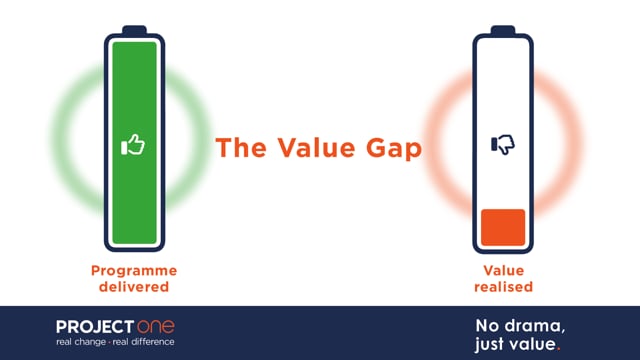
Many organisations focus heavily on getting the programme live but underestimate the importance of sustainment. Without reinforcement, employees often revert to previous behaviours, reducing the long-term value of transformation investments. Successful sustainment strategies include:
Ongoing leadership sponsorship
Reinforcement communications
Continuous training
Adoption monitoring
Recognition programmes
Process governance
When adoption is embedded into normal day-to-day operations, change becomes part of organisational culture rather than a temporary initiative.
Key points for delivering change at scale
Organisations that consistently succeed with large-scale change share several common characteristics:
They test before they scale
They use pilots to reduce risk and gather insights
They celebrate and communicate early wins
They implement phased, structured change rollouts
They adapt approaches to individual business units
They maintain strong governance and leadership support
They collect continuous feedback throughout implementation
They invest in long-term sustainment.
These practices help organisations move beyond project completion and achieve lasting behavioural and operational change.
Delivering successful change implementation at scale requires more than a well-designed solution. It demands a disciplined approach that combines pilot testing, effective change rollouts, visible early wins and ongoing reinforcement.
Whether in defence, finance, or retail environments, organisations that learn before scaling, communicate progress effectively and continuously adapt their approach are far more likely to achieve sustainable outcomes.
By starting small, measuring success, building momentum, and embedding new ways of working through sustainment, leaders can transform ambitious initiatives into lasting organisational capability. Ultimately, successful large-scale change is not about moving fast – it is about moving forward with confidence, evidence, and a clear path to adoption.
Do you need Change Management expertise?
At Project One, our team of change experts and Transformers all have a minimum of 15-20 years of experience in leading complex change and transformation programmes, across all sectors. If you are embarking on or already delivering a transformation programme and would like some guidance or just a sounding board, please get in touch.

 How drama free is your change programme? take our free programme health check
 Our change and transformation Podcast Listen to our latest Podcast