Overcoming cultural resistance by building an innovation mindset, change culture and organisational learning speed.
Organisations rarely fail because they cannot see change coming. More often, they struggle because they continue interpreting new challenges through old assumptions.
In that environment, cultural resistance is not simply a people issue. It is a strategic risk.
Few phrases capture that risk more clearly than: “We’ve always done it this way.”
On the surface, it can sound harmless. Established ways of working often exist because they once solved real problems. But when experience hardens into fixed thinking, organisations struggle to develop the innovation mindset and change culture needed to respond at pace.
The real challenge is not changing people’s minds, its changing the organisational conditions that make old thinking feel safer than new learning.
The real problem: learning slower than the market
Many organisations do not have a change problem, they have a learning problem.
They can launch programmes, redesign operating models, implement platforms and communicate new strategies. But if the organisation cannot question assumptions, test new approaches and absorb learning quickly, transformation will always feel harder than it should.
The danger of “we’ve always done change this way” is not the phrase itself. The danger is that tomorrow’s decisions are made through yesterday’s logic.
In one transformation programme, a leadership team spent six months debating the design of a process that everyone privately acknowledged was broken. The issue was comfort, not capability. The existing process was familiar and familiarity often feels safer than improvement.
This is where legacy thinking becomes organisational gravity. Teams protect familiar processes, governance reinforces established decision routes, experts defend what has worked before and leaders ask for innovation but continue rewarding predictability. Over time, the organisation becomes highly capable at repeating the past and less capable of adapting to the future.
In stable markets, this may slow improvement. In volatile markets, it becomes a source of competitive disadvantage.
The organisational learning equation
A useful way to think about this is through the Organisational Learning Equation: Curiosity × Psychological Safety × Experimentation = Transformation success
If any one of these factors is weak, change slows down.
Without curiosity, people stop questioning whether existing ways of working remain fit for purpose
Without psychological safety, people avoid challenge because it feels risky
Without experimentation, new ideas remain theoretical and never become reality.
This is why culture matters commercially. A stronger change culture does not just make people feel more positive about transformation. It helps organisations make better decisions, adopt change faster, realise benefits sooner and reduce the cost of repeated rework.
In that sense, learning speed is becoming a source of competitive advantage.
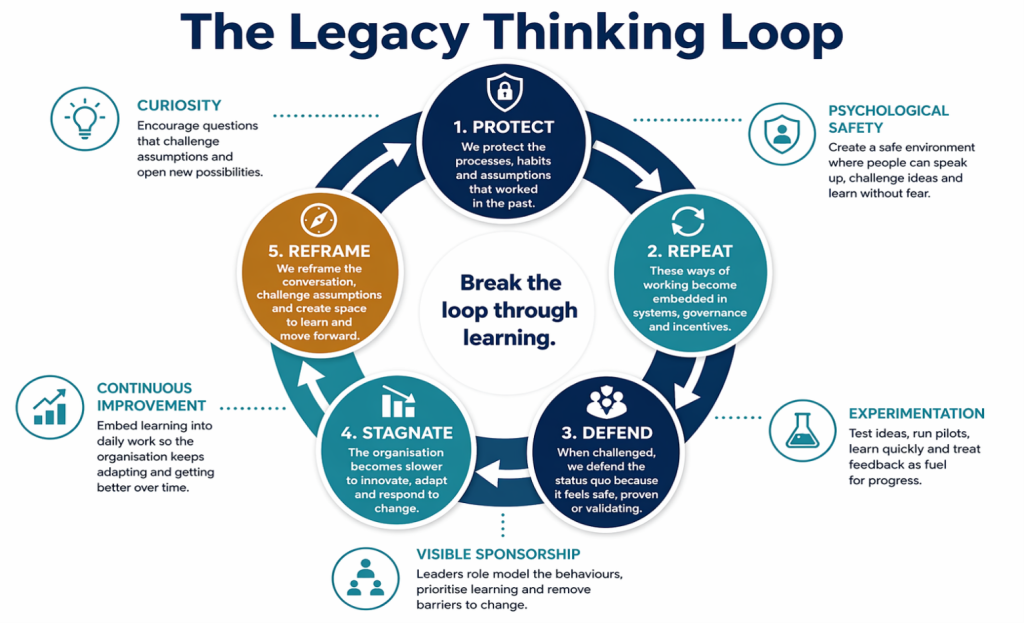
The legacy thinking loop
The “we’ve always done change this way” mindset often follows a predictable pattern.
First, organisations protect the processes, habits and assumptions that made them successful. They then repeat those ways of working until they become embedded in systems, governance and incentives. When challenged, teams defend the current model because it feels safe, proven or professionally validating. Eventually, the organisation begins to stagnate, becoming slower to innovate, slower to adopt change and less responsive to external drivers.
Breaking the loop requires leaders to reframe the conversation.
The aim is not to dismiss the past. Strong change cultures do not reject experience they interrogate it. They ask what should be retained, what should be adapted and what must now be retired.
That distinction matters, people are more likely to challenge legacy thinking when they feel their expertise is being used to shape the future, not blamed for holding it back.
Five signs legacy thinking is holding back your change
For senior leaders, the warning signs are often visible before transformation stalls:
Decisions are justified by precedent rather than evidence
Governance protects the current model more than it enables the future one
Pilots are expected to prove perfection rather than generate learning
Employees wait for permission rather than test sensible improvements
Leaders ask for innovation but continue rewarding compliance.
These are not isolated behaviours, they are signals that the organisation’s operating environment is making old thinking safer than new learning. This is why culture cannot be treated as a communications theme. Culture is the system of behaviours, beliefs and reinforcements that determines how work really gets done.
From innovation theatre to innovation discipline
Many organisations say they want innovation but fewer are willing to change the conditions that allow innovation to happen.
The result can be “innovation theatre”: workshops, campaigns and idea-generation sessions that create energy but do not materially change how decisions are made, how risk is managed or how investment is prioritised.
A genuine innovation mindset requires more discipline than that. Leaders need to create practical routes for curiosity, experimentation and learning to influence real decisions.
That means asking better questions:
What problem are we really trying to solve?
What assumptions are we carrying forward?
What evidence would cause us to change course?
Where can we test this safely before scaling?
What have we learned that should change our approach?
This shifts innovation from a slogan to a leadership practice.
Our article on culture as a catalyst for transformation reinforces the importance of growth mindset, psychological safety, inclusivity, values alignment and continuous improvement in creating cultures that support transformation.
What this looks like in practice
In our experience, cultural shift is rarely achieved through messaging alone. It requires structure, sponsorship and repeated behavioural reinforcement.
In our work with a leading airline on operating model transformation, we supported a customer facing post-pandemic recovery challenges, a growing IT change portfolio, legacy ways of working and resistance linked to a new Target Operating Model. The lesson was clear. Tackling legacy thinking is not just about persuading people to think differently. It often requires new roles, clearer accountabilities and hands-on support to make the future model real.
Our work with Alternative Futures Group provides another example. The case study describes baseline culture measurement, leadership engagement, governance through an Executive Sponsor, Steering Committee and Project Working Group, a 30+ strong change network, leadership workshops and a Culture Blueprint.
The Logistical Support Services customer story shows a similar challenge, where rapid expansion had outpaced internal structures. We helped align leadership, clarify accountabilities and establish practical routines to support future growth.
Across these examples, the message is consistent, sustainable change is not created by activity alone. It is created by changing the operating conditions that shape behaviour to deliver real value.
From protecting the past to shaping the future
Past success is not a guarantee of future relevance.
For leaders, the question is no longer simply: “Are people resisting change?” It is: “Have we created a culture where people can learn faster than the world is changing around them?”
That requires visible sponsorship, psychological safety, practical experimentation and continuous improvement. It requires leaders to reward curiosity as well as confidence, learning as well as delivery and adaptation as well as control.
The “we’ve always done change this way” mindset will not disappear because an organisation communicates a new vision. It changes when people experience a different set of conditions: where challenge is welcomed, learning is acted on and new behaviours are reinforced until they become the normal way of working.
In that sense, cultural resistance, innovation mindset and change culture are not soft topics. They are strategic conditions for transformation success.
Project One can help
If you’re facing barriers to change, let’s tackle them together. Start a conversation with one of our change experts about how to overcome resistance and accelerate your transformation. Please get in touch here.

 How drama free is your change programme? take our free programme health check
 Our change and transformation Podcast Listen to our latest Podcast