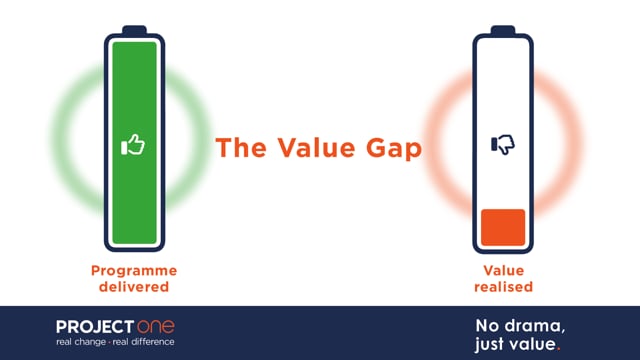
Ask most project teams what’s in their change management plan and you’ll hear the usual suspects: communications, training, stakeholder engagement, leadership alignment. Rarely does anyone volunteer “reward and recognition.” And yet, when a change programme stalls — when change adoption plateaus, energy dips and people quietly revert to the old way of doing things — the absence of a structured recognition system is almost always a contributing factor.
This isn’t an incidental oversight. It’s a costly one.
The business case, in plain terms
Recognition isn’t a nice-to-have bolt-on. The evidence for its impact on motivation and performance is substantial.
A McKinsey study found that 67% of employees rated praise and acknowledgement as their top motivator for performance — placing it above financial incentives. Gallup’s research consistently shows that employees who receive regular recognition are 2.5 times more likely to be satisfied in their roles and 1.5 times more likely to feel motivated to do their best. And in organisations where recognition programmes are working well, the effect compounds: employees are five times more likely to feel valued, six times more likely to invest discretionary effort, and seven times more likely to stay with their employer for the following year (Globoforce/WorkHuman, 2023).
Now apply that to a change context. If you’re trying to drive change adoption across a sceptical workforce, persuading people to let go of familiar habits, learn new systems, or work in fundamentally different ways, you need every motivational lever available. Recognition is one of the most powerful and the most underused.
Why change programmes so often get this wrong
Prosci’s ADKAR model is one of the most widely used frameworks in change management as it includes Reinforcement as its fifth and final building block, specifically because adoption doesn’t stick without it. Yet in practice, reinforcement is frequently the element that gets squeezed when timelines tighten or budgets come under pressure.
The result? People make the effort to adopt new behaviours during the project phase, receive little acknowledgement for doing so and gradually drift back. The change may technically have been “delivered,” but real adoption — the sustained, embedded kind — never quite lands.
Part of the problem is a conflation of two things that are actually quite distinct. Hansen, Smith and Hansen (2002), writing in Compensation & Benefits Review, noted that reward and recognition are usually treated as synonyms, but represent a fundamental duality in human motivation. Formal recognition systems, structured schemes, incentive programmes and milestone-based rewards serve one purpose. Day-to-day recognition is something different: more immediate, personal and human. A manager noticing effort and naming it, publicly or privately, costs nothing and often lands better than any formal scheme. Both have a role in sustaining change adoption, but organisations frequently invest in one at the expense of the other.
What good looks like in practice
Whether you’re designing a formal recognition system or simply trying to build better habits into how your managers lead, the principle is the same: make motivation an explicit part of how the change is managed, not an afterthought once it’s delivered.
A few things that work:
- Make the behaviour visible. If you want people to adopt a new way of working, name it when you see it. A team leader acknowledging someone who went out of their way to use the new system — in a team meeting, in a project update — costs nothing and signals clearly what’s valued.
- Align recognition to milestones, not just outcomes. Don’t wait for go-live or sign-off. Recognise effort during the transition, especially when things are hard. Progress deserves acknowledgement too.
- Make it personal. Gallup’s research is clear that money isn’t the only — or even the primary — form of recognition most people respond to. Personalised, specific, timely recognition from a direct manager consistently outperforms generic reward schemes.
- Build it into manager behaviours. Gallup finds that 70% of the variance in team engagement is attributable to the manager. Training managers to recognise and reinforce new behaviours is one of the highest-leverage investments a change programme can make.
We worked with a client who introduced an entirely new ‘One Finance’ category to their prestigious annual awards programme, to recognise individuals and teams who displayed the new ‘ways of working’ that were required to realise their modernisation vision. At the less formal end of the scale, on my programme we enjoyed a complimentary sushi lunch in the office, and the Group HR Director dropped by to chat to team members and thank them for the work they have been doing to deliver a new global HR system. Examples of how both formal recognition systems and engaged leadership behaviours can both make teams feel valued and motivated.
A thought to close with
Change programmes tend to invest heavily in the beginning by building the case, communicating the vision, training people on what’s new. Recognition and reinforcement are about sustaining momentum through the messy middle and beyond go-live. Without them, even the best-designed change tends to fade.
If your organisation is navigating a significant transformation and you want to make sure adoption actually sticks, we’d love to talk. theteam@projectone.com

 How drama free is your change programme? take our free programme health check
 Our change and transformation Podcast Listen to our latest Podcast