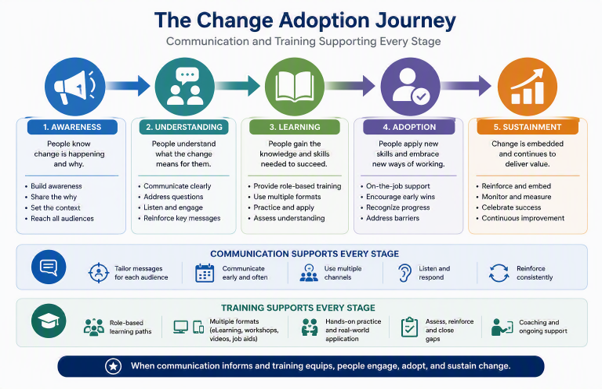
Effective change communication and change training are fundamental to ensuring people understand, accept and adopt new ways of working. Without clear communication and structured employee learning, organisations often experience confusion, resistance, delays and reduced returns on investment.
Whether implementing new technologies, transforming operating models or responding to regulatory requirements, organisations must provide employees with both the information and skills needed to succeed. When communication and training work together, they increase engagement, build confidence and significantly improve long-term adoption outcomes.
Why communication and training matter
Many change initiatives fail because employees either do not understand why change is happening or lack the skills required to succeed within the new environment. Communication answers key questions such as:
Why is the change happening?
What are the expected benefits?
How will employees be affected?
What support is available?
Training addresses different questions:
What do I need to learn?
How do I perform new tasks?
Where can I get support?
How will success be measured?
Together, communication and training create a bridge between awareness and adoption.
The key components of a change communication plan
An effective communication plan ensures stakeholders receive the right information at the right time through the right channels.
Clear objectives
Communication should support specific change outcomes. Common objectives include:
Building awareness
Creating understanding
Increasing commitment
Encouraging engagement
Reinforcing adoption
Every communication activity should align to one or more of these objectives.
Audience segmentation
Different stakeholder groups have different concerns and information requirements. Examples include:
Executive leaders
People managers
Frontline employees
Customers
Partners and suppliers
Tailoring messages improves relevance and engagement.
Core change messages
Many organisations maintain message consistency across all communications. Core messages typically cover:
The reason for change
Organisational benefits
Employee impact
Timescales
Available support
Consistency helps reduce confusion and rumours.
Communication channels
Using multiple channels helps maximise reach and engagement. Common channels include:
Town hall meetings
Leadership briefings
Email campaigns
Intranet updates
Video messages
Team meetings
Frequently Asked Questions (FAQs)
No single communication channel reaches everyone effectively.
Two-way feedback
Communication should never be a one-way process. Employees should have opportunities to:
Ask questions
Raise concerns
Share ideas
Provide feedback
Two-way communication builds trust and strengthens engagement throughout the change journey.
The connection between communication, training and engagement
Communication and training are often treated as separate activities, but they are most effective when integrated. Before people can learn, they need to understand the purpose behind the change so without communication, employees may see training as unnecessary or irrelevant.
Once employees understand the need for change, training equips them with the skills required to succeed and proper training reduces uncertainty and increases confidence. Employees who understand the rationale for change and feel equipped to succeed are more likely to engage positively with new processes and behaviours.
Effective change training approaches
Different learners require different approaches. Organisations should provide a blend of learning formats to maximise effectiveness.
Workshops – Instructor-led workshops are ideal for:
Interactive learning
Group discussions
Practical exercises
Scenario-based activities
Workshops encourage collaboration and allow employees to ask questions in real time.
eLearning – Provides flexibility and scalability. Benefits include:
Self-paced learning
Consistent content delivery
Lower delivery costs
Easy tracking and reporting
Large organisations often rely on eLearning when deploying change across multiple locations.
Town Halls – While often viewed as communication activities, town halls can also support learning. Leaders can:
Demonstrate new capabilities
Explain expected changes
Share case studies
Answer employee questions
Town halls help strengthen transparency and trust.
Coaching and Mentoring – Personalised support helps employees apply learning in real world situations. Managers and coaches can reinforce training through:
Guidance sessions
Performance conversations
On-the-job support
Problem-solving discussions
This approach is particularly useful for complex or behavioural changes.
Job aids and quick reference guides – Employees often need support after formal training. Useful resources include:
Process guides
Checklists
Knowledge articles
Video tutorials
Frequently Asked Questions
These materials support ongoing learning and adoption.
Common mistakes to avoid
The following common mistakes can undermine otherwise strong change initiatives:
Communicating too late – Employees should hear about change from leaders, not rumours.
Information overload – Keep messages clear, relevant, and well-timed.
One-time training – Learning continues beyond initial training with ongoing support.
Ignoring managers – Equip managers so they can effectively support their teams.
Communication helps employees understand why change matters, while employee learning equips them with the knowledge and skills needed to succeed. By developing structured communication plans, using a mix of learning approaches, organisations can improve engagement, accelerate adoption and achieve more sustainable outcomes.
Ultimately, successful change delivery is not simply about informing people or providing training – it is about creating understanding, building confidence and enabling people to embrace change with clarity and commitment.
Do you need Change Management expertise?
At Project One, our team of change experts and Transformers all have a minimum of 15-20 years of experience in leading complex change and transformation programmes, across all sectors. If you are embarking on or already delivering a transformation programme and would like some guidance or just a sounding board, please get in touch.

 How drama free is your change programme? take our free programme health check
 Our change and transformation Podcast Listen to our latest Podcast