Organisations which are most successful at not only delivering but sustaining transformation are those who instil a culture of continuous improvement. They recognise the world is constantly changing, and employees should be empowered to continuously seek opportunities for further enhancements and growth. The employees experiencing change are best positioned to inform organisations on lessons learned, highlighting what is working well and where further improvements can be made.
Feedback loops are a core mechanism of Continuous Improvement because they provide ongoing information about how well a process, product, or service is performing. By regularly collecting, analysing, and acting on feedback, organisations can make small, incremental improvements to maximise process optimisation rather than waiting for major problems to occur.
How Feedback Loops Inform Incremental Improvements
Feedback loops:
Identify Performance Gaps
Feedback reveals where current performance does not match the desired outcomes.
Sources can include customer surveys, employee suggestions, quality metrics, audits, and performance data.
This helps teams identify specific areas needing improvement.
Enable small, manageable changes
Continuous feedback allows issues to be detected early, before they become bigger issues.
Instead of implementing large-scale changes, teams can make small adjustments which are often faster to implement and monitor the results.
This reduces risk and minimises disruption.
Support Evidence-Based Decision Making
Feedback loops provide evidence on what is working and what is not.
Teams can prioritise improvements based on actual results rather than assumptions.
Encourage Learning and Adaptation
Each improvement can be tested to see whether it works and generates new feedback. If it doesn’t work, a further improvement can be made creating a cycle of experimentation and refinement. This is the essence of Plan, Do, Check, Act (PDCA).
Organisations therefore learn from both successes and failures.
Promote Employee Ownership and Customer Engagement
Employees and customers often identify practical opportunities for improvement.
Incorporating their feedback increases buy-in and leads to more relevant changes.
When employees see their feedback being acted on, they are more likely to participate in future feedback and support the change.
What methods can be used to capture feedback
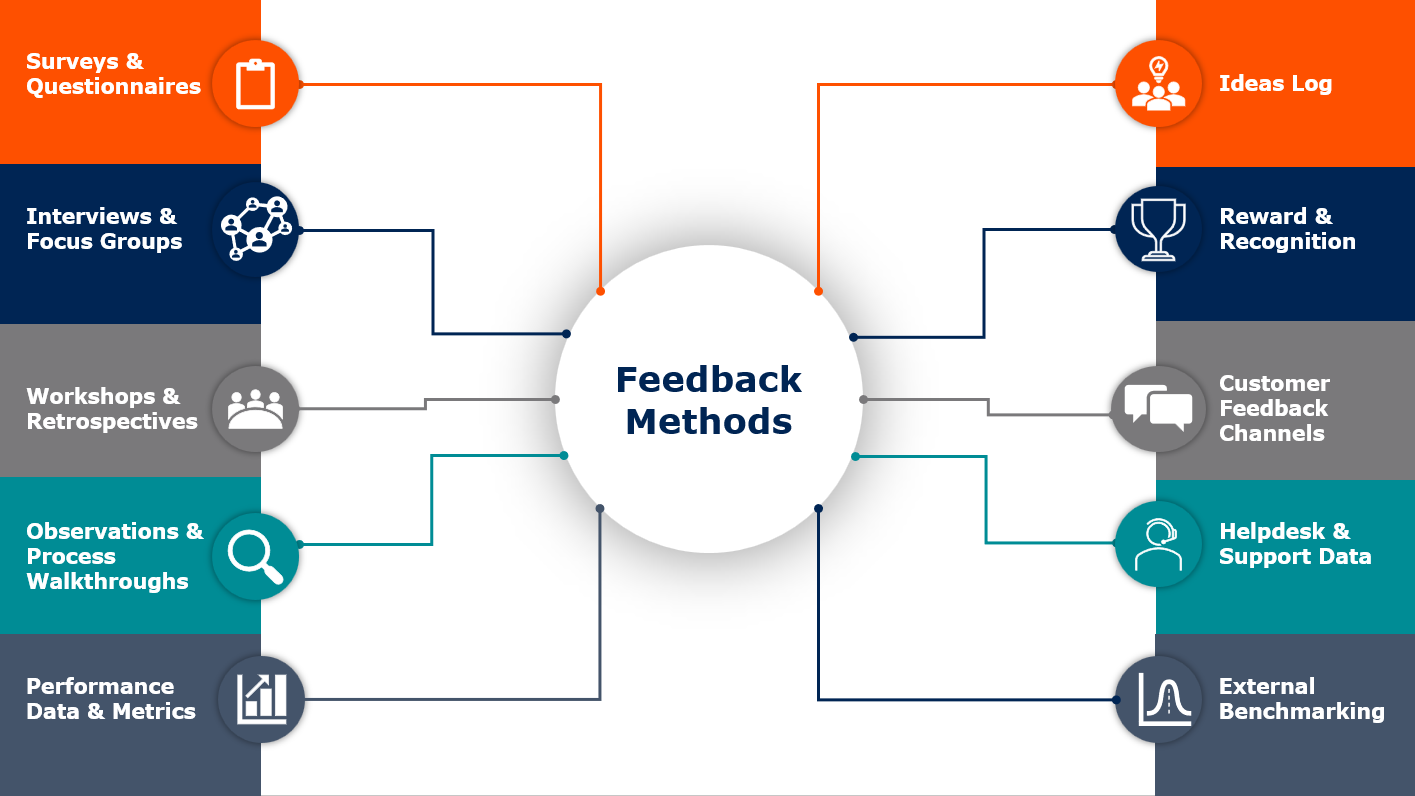
There are several methods of capturing feedback below and a good approach is to use a combination of methods which provide both qualitative and quantitative feedback.
Feedback Method
Advantages
Surveys and questionaires
Easy to distribute to large groups
Quantifiable results
Trend analysis
Interviews and focus groups
Provides rich qualitative data
Encourages discussion
Helps to find root causes of issues
Workshops and retrospectives
Encourages collaboration
Enables discussion of issues and lessons learned
Supports collective problem-solving
Observations and process walkthroughs
Provides evidence of the reality
Reveals opportunities which may be missed
Performance data and metrics
Provides objective feedback
Highlights trends & recurring problems
Supports data driven decision making
Ideas log
Generates ideas
Encourages continuous participation
Empowers employees
Reward and recognition
Motivates employees
Increases employee engagement
Reinforces positive behaviours
Customer feedback channels
Captures the Customer voice
Identifies service gaps
Helps prioritise improvements
Helpdesk and support data
Highlights immediate issues
Identifies trends
Identifies root cause of issues
External benchmarking
Identifies best practices
Reveals performance gaps
Generates improvement targets
How does feedback help to sustain engagement beyond Go-Live
Feedback is essential for sustaining engagement beyond go-live and embedding change, as it demonstrates employees are being heard, supported and actively encouraged to participate and own future improvements. It reinforces that transformation is ongoing and does not stop once the programme has been implemented.
Feedback:
Demonstrates That User Input Matters
When organisations actively collect and act on feedback, users can see their experiences and suggestions influence future improvements. This creates a sense of ownership and encourages continued participation.
Identifies Emerging Issues Early
Post-go-live feedback helps uncover issues which may not have been evident during testing such as confusion around processes, workarounds being developed, system usability, training gaps or inconsistent behaviours.
Addressing these challenges quickly helps maintain user confidence and prevents disengagement.
Supports Continuous Learning
Feedback reveals where users need additional support, training, or guidance. Organisations can respond by providing targeted resources that help users become more confident and proficient over time.
Builds Trust and Transparency
Regularly sharing feedback received, the actions taken and the planned improvements demonstrates transparency. Users are more likely to remain engaged when they know their concerns are acknowledged and addressed.
Drives Incremental Enhancements
Realistically, no solution will be perfect at launch. Feedback enables organisations to make small, continuous improvements that enhance the user experience and increase satisfaction over time.
Creates Change Champions
Users who see their suggestions implemented often become advocates for the solution. These champions can encourage colleagues to adopt new features, share best practices, and contribute further ideas.
Feedback sustains engagement and facilitates the cycle of Continuous Improvement. When employees see their suggestions being translated into impactful enhancements, they are more likely to remain engaged and be part of the evolution of the change. If you’d like to learn more about tackling continuous change effectively, you can listen to the Transformation Talks Podcast here.
Do you need Change Management expertise?
At Project One, our team of experienced change and programme management professionals brings hands-on expertise to drive complex transformation programmes. We combine leadership, governance, and delivery capability to help customers achieve sustainable business performance improvements faster and with greater certainty. If you are embarking on or already delivering a transformation programme and would like some guidance or just a sounding board, please get in touch via theteam@projectone.com.

 How drama free is your change programme? take our free programme health check
 Our change and transformation Podcast Listen to our latest Podcast