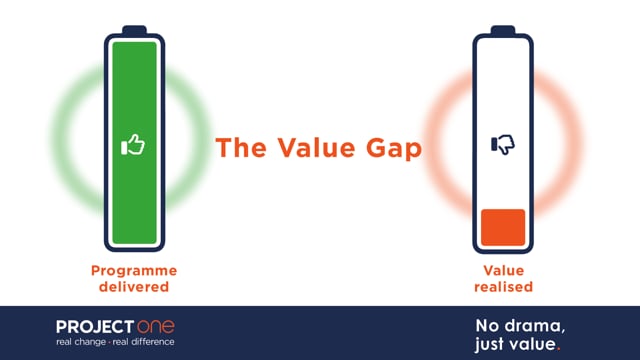
Organisations pour millions into change initiatives, expecting efficiency, productivity, and growth. Yet, time and again, they fall short. Not because the strategy was flawed, but because of one simple truth:
Change doesn’t create benefits, adoption does, and adoption doesn’t happen by accident.
Change isn’t complete when the plan is delivered, it’s only successful when it results in real, measurable outcomes. That’s where Change Management truly proves its value.
Change Management is critical for benefits realisation because the success of any change initiative depends on people adopting and using new processes, systems, or behaviours. Without proper Change Management, even the most well-planned projects may fail to deliver their intended benefits.
The Real Reason Change Fails
Organisations can fall into the trap of obsessing over the mechanics of change; the technology, the processes, the structure, but neglect the human side of change.
This is the silent killer of transformation efforts: the assumption that change automatically leads to benefits. It doesn’t. Change is introduced; benefits are realised. The space between them is where Change Management lives.
The Investment That Pays for Itself
When you invest in structured Change Management, everything shifts:
- Adoption accelerates. Employees understand the why, not just the what.
- Resistance decreases. People feel involved, not imposed upon.
- ROI increases. The faster people embrace change, the sooner benefits materialise.
- Long-term success is secured. Change doesn’t just happen, it sticks.
Why Change Management is Critical for Benefits Realisation
Ensure Adoption and Usage
- The benefits of a change (e.g., increased efficiency, cost savings, improved customer experience) can only be realised if employees and stakeholders embrace and use the new ways of working.
- Change Management provides structured support (communication, training, leadership engagement) to drive adoption.
Reduces Resistance and Ensure Engagement
- Resistance to change can slow down or completely derail the realisation of benefits.
- A strong Change Management strategy addresses concerns, involves key stakeholders, and fosters a culture of acceptance.
- Change Management creates a culture of acceptance through communication, leadership alignment, and active engagement.
Aligns Change with Business Goals
- Change Management ensures that employees understand how the change aligns with business objectives.
- When people see the value of the change, they are more likely to support and sustain it.
Accelerates the Realisation of Benefits
- Poorly managed change leads to delays in adoption, making it longer for benefits to materialise.
- Effective Change Management ensures a smoother transition, reducing the time it takes for the organisation to start seeing results.
Sustain Benefits Over Time
- Benefits realisation is not just about achieving short-term wins but ensuring long-term impact.
- Change Management includes reinforcement strategies (ongoing training, leadership support, performance tracking) to prevent regression to old ways of working.
Mitigates Risks of Project Failure
- Studies show that projects with strong Change Management are more likely to meet objectives and deliver expected benefits.
- Without Change Management, even technically successful projects can fail due to lack of user adoption.
Conclusion: Change Management, the Missing Link in Benefits Realisation
Understanding the human side of change is the first step. But to turn intent into impact, organisations must treat Change Management not just as a support function – but as the strategic enabler of value realisation.
Change Management isn’t just important, it’s the bridge between delivering a project and realising its full value. It ensures that people, who are the key drivers of change, successfully transition to new ways of working, allowing organisations to achieve and sustain the intended benefits. Without it, even the best initiatives risk underperformance or failure.
Do you need Change Management expertise?
Implementing change and transformation is fundamentally about winning over people’s hearts and minds. The path to full adoption starts with a strategic vision, laying the groundwork for the transformation ahead. This is also the initial step in a comprehensive Change Management approach. At Project One, our change experts and ‘Transformers’ have extensive experience in helping our customers through this process so if you’d like to learn more or just need a sounding board, please get in touch via theteam@projectone.com.
You can also visit this webpage to read more about the four steps to effective change management including Step 1) Lay the foundations, Step 2) Plan and prepare, Step 3) Bring the change to life and Step 4) Realise the value.

 How drama free is your change programme? take our free programme health check
 Our change and transformation Podcast Listen to our latest Podcast